From analysis to briefing to the published page - all in one environment. It belongs to you, runs in your own accounts and adapts through Claude Code. Your data sources stay exactly as they are.
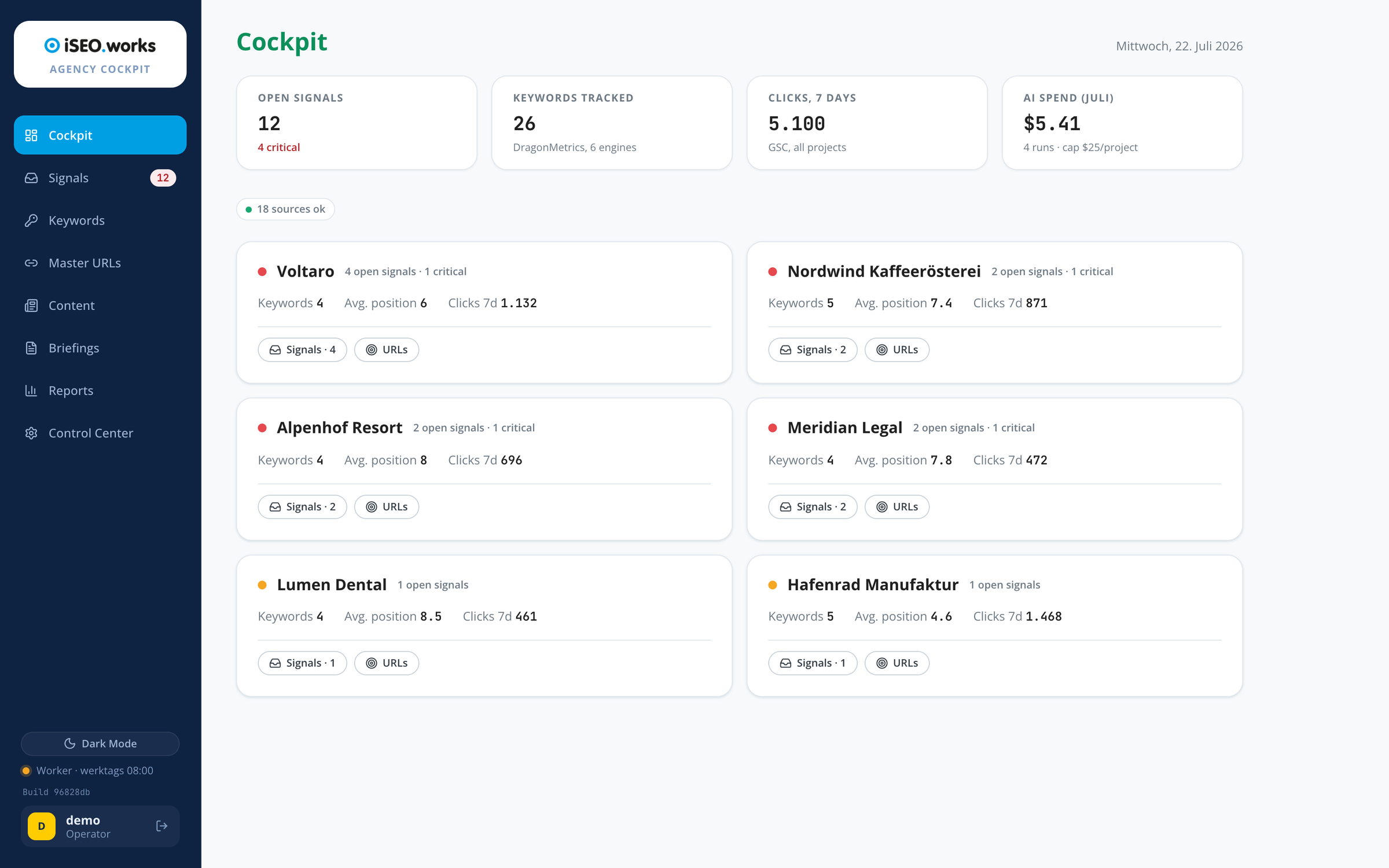
⤢ Enlarge
Real view from the system · demo projects · click to enlarge
Rank trackers, Search Console, Analytics: every tool delivers numbers, none of them tells you which ones matter today or what to do about them. The diagnosis stays manual work - every day, for every project.
ChatGPT, Perplexity and AI Overviews have been recommending brands and products for a while now. Whether yours is among them is something your classic SEO setup does not measure. Visibility is shifting - and without measurement you notice only when the inquiries stop coming.
You could build the system for this yourself. Budget hundreds of hours of development.
Or you take over one that already runs.
RankCockpit is not one feature but eight interlocking modules - each one grown out of real agency work, not out of a pitch deck. From the analysis to the action taken, you stay in one environment.
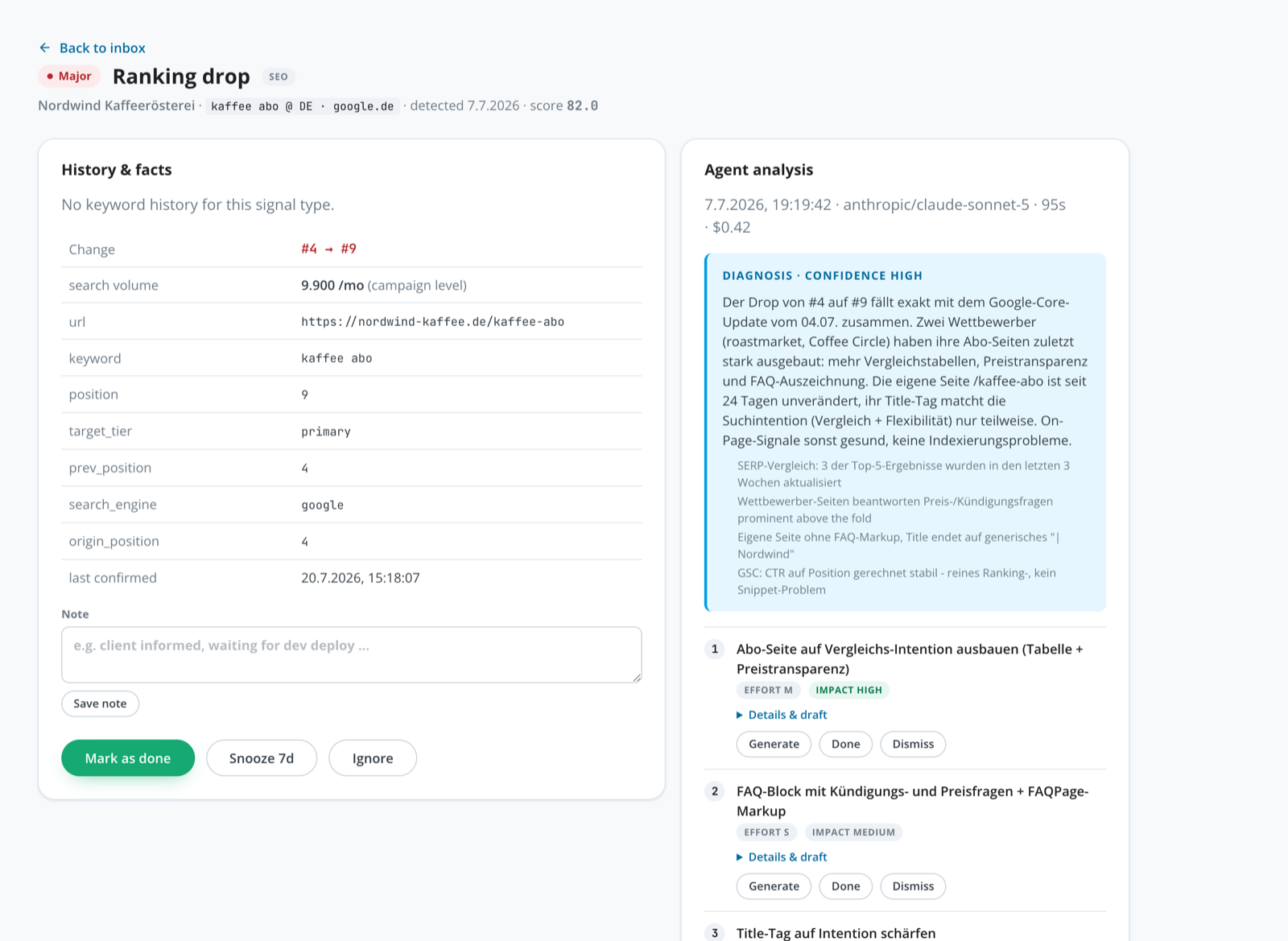
Every working day RankCockpit checks rankings, clicks and AI visibility across all projects and reports prioritized signals - from a ranking drop to a lost ChatGPT recommendation, weighted by revenue relevance. At the push of a button the analysis agent researches the root cause with evidence and delivers actions with effort and impact. In daily practice that means you open one inbox in the morning instead of five tools - and you know what matters today.
Learn more →Harvests real Google data and lets an LLM judge cut ruthlessly. A run harvests several hundred candidates; what remains is a few dozen clusters with substance - classified as money or blog clusters, with priority, difficulty and a ready title and structure proposal. The work is not in the collecting, it is in the throwing away. A run costs one to two dollars and gives you a working basis that leads straight into the briefing.
Learn more →A kanban board carries every piece of content from idea through draft and review to published - blog articles and LinkedIn posts on the same board, with a built-in editor. Auto-publish ships on the cadence you choose. In daily practice: your projects keep their publishing frequency without you having to think about it every day - and nothing goes live that you have not approved.
Learn more →Project, target URL, focus keyword - one click: a complete page briefing appears as a Google Doc in your Drive, based on the project's real data and written in your style. Cost: under a dollar. In daily practice it replaces the hour you would otherwise spend assembling structure, keywords and competitor notes by hand - from signal to writer briefing in minutes.
Learn more →The page register lists every target URL with its focus keyword and live data - position, volume, impressions, clicks - from rank tracking and Search Console. Built-in cannibalization protection warns you before two of your own pages start pushing each other out. In daily practice: before you plan a new page, the register tells you whether it will get in the way of an existing one.
Learn more →One click produces a monthly report per client: a plain-language summary, the numbers, what was implemented, the outlook - AI visibility included. You review and approve; only then does the client see it. In daily practice this turns the end-of-month reporting marathon into half an hour of reviewing and approving.
Learn more →Every prompt in the system is editable, every LLM selectable - globally or per client, billed transparently through OpenRouter. This is where your own preferences, hard-won lessons and tricks move into the system: the cockpit does not work like some generic tool, it works like you. No black-box feeling, no hidden prompts.
Learn more →Every client gets their own login with their own content section - feature switches let you control what they see and what they may do, right down to their own prompts and their own LLM per client. White-label from the start. In daily practice: your client works inside their own area without ever seeing your cockpit or any other client.
Learn more →Every source sits behind an adapter layer: Google Search Console, GA4, DragonMetrics, Rankscale, DataForSEO and Google Docs deliver data today, and if you use other tools you swap the connector with Claude Code. The principle: any system Claude Code can reach through an MCP server or an API can be connected.
Anyone with enough time could build the code. What you cannot quickly rebuild are the decisions inside it - grown out of many years of international SEO and GEO work:
This is not a feature list from a pitch deck. It is the working method of an agency that uses it every day.
No cloud of ours, no vendor lock-in. You get the complete system and run it yourself - your Claude Code handles the technical work.
You receive your private copy of the complete system: code, setup documentation and the operator handbook.
You open the folder in Claude Code and say "install me." Your Claude works through the included runbook step by step.
Database, hosting, Google access, AI models: everything runs in your own accounts. Your data never leaves your control.
Every working day in the morning: data sync, signal engine, digest. On your machine - or later in the cloud, the migration guide is included.
RankCockpit is built for working with Claude Code - installed, steered and extended in conversation. Concretely that means:
// You, in Claude Code:
> Add a signal rule: warn me when a product page loses clicks three days in a row.
// Your Claude: creates the rule, tests it - from tomorrow it is part of the daily run. Your system.
The market is full of auto-SEO magic that disappoints. So we would rather tell you up front what you do not get:
If you are looking for a magic tool, RankCockpit is not for you.
If you want a professional instrument, you are in the right place.
RankCockpit is not a concept. It is the instrument an international SEO agency uses to look after its client projects. Three real findings from practice:
0 / 61
One client was completely invisible in AI answers: zero hits across 61 measured queries, while competitors were being recommended. No classic tool had reported it.
Pos. 2 → 14
A ranking drop on a revenue-relevant keyword, caught on day one. The agent diagnosed core-update volatility - with evidence and proof of recovery instead of panic.
8 × cannibalization
Eight pairs of pages pushing each other out of the rankings - uncovered on the first day after a project's Search Console was connected.
This is what an agent analysis looks like: diagnosis with evidence, prioritized actions with effort and impact · demo project
The price depends on how many people work with it - not on which features you get. Those are the same at every tier.
Freelancer
Up to 3 people
€1,790
one-time · plus VAT · no subscription
Agency
4 people and up
from €3,900
one-time · plus VAT · fixed price by team size
Custom
Your own stack, several brands
On request
fixed price after a scoping call
Every tier gives you the same source code and the same eight modules. What differs is how many people the license covers and how much setup we do together. If you grow, you license up - without buying again.
Secure payment via Stripe · prices plus VAT · Your purchase is subject to our terms and license conditions.
Not sure which tier fits? Book the 15-minute demo.
A Mac, Claude Code and your own accounts with the services the system runs on: a Postgres database (Supabase, the free tier is enough to start), static hosting (Netlify, free), AI access (OpenRouter) and your Google access (Search Console, optionally Analytics). Rank tracking and AI visibility services are optional extras - you can start with Search Console alone.
No. Your Claude Code runs the setup from the included runbook, in conversation. You should be willing to work with Claude Code - that is writing, not programming. If you can code, extending it will still be easier for you.
In the reference setup with six projects: around $15 per month for the AI analyses, plus the free or entry-level plans from Supabase and Netlify depending on how far you scale. One agent analysis costs about $0.10. Optional services (rank tracking, AI visibility measurement) have their own pricing - you decide what to connect.
For twelve months you get repo updates that absorb such changes, included. After that you decide: leave it running as it is, adapt it yourself (your Claude Code helps) or take an optional update package.
Yes, expressly. The system is built for multiple clients: separate projects, client logins with their own view, feature switches, and even individual prompts and AI models per client. Only reselling the system itself is excluded.
Because tools of this kind no longer need a subscription. Software you steer and extend with an AI agent is worth more when it belongs to you: no price increases, no waiting for features, no dependency on a vendor. We earn from handing over our groundwork, not from your monthly rent.
Within 24 hours you get the invitation to your private repo copy and we schedule the onboarding session. In those two hours we set everything up together: accounts, access, first data sync, first signals. After that your system runs by itself every working day.
As of today RankCockpit is developed and tested Mac-first. Running it on Windows through Docker is possible but not yet part of the guided setup. If you are on Windows, talk to us before buying - an honest answer is guaranteed.
I am Udo Leinhaeuser. I have run an international SEO agency for over ten years and owned a translation company before that. I built RankCockpit for my own agency work because no tool on the market brought early warning, AI visibility and concrete actions together. It runs every working day for my client projects. Now I am handing it over to anyone who wants to work with it - every handover in person, with onboarding.
Take over a system that does real agency work every working day - and belongs to you from the handover on.